Privacy Blockchains Compared: Six Models Explained
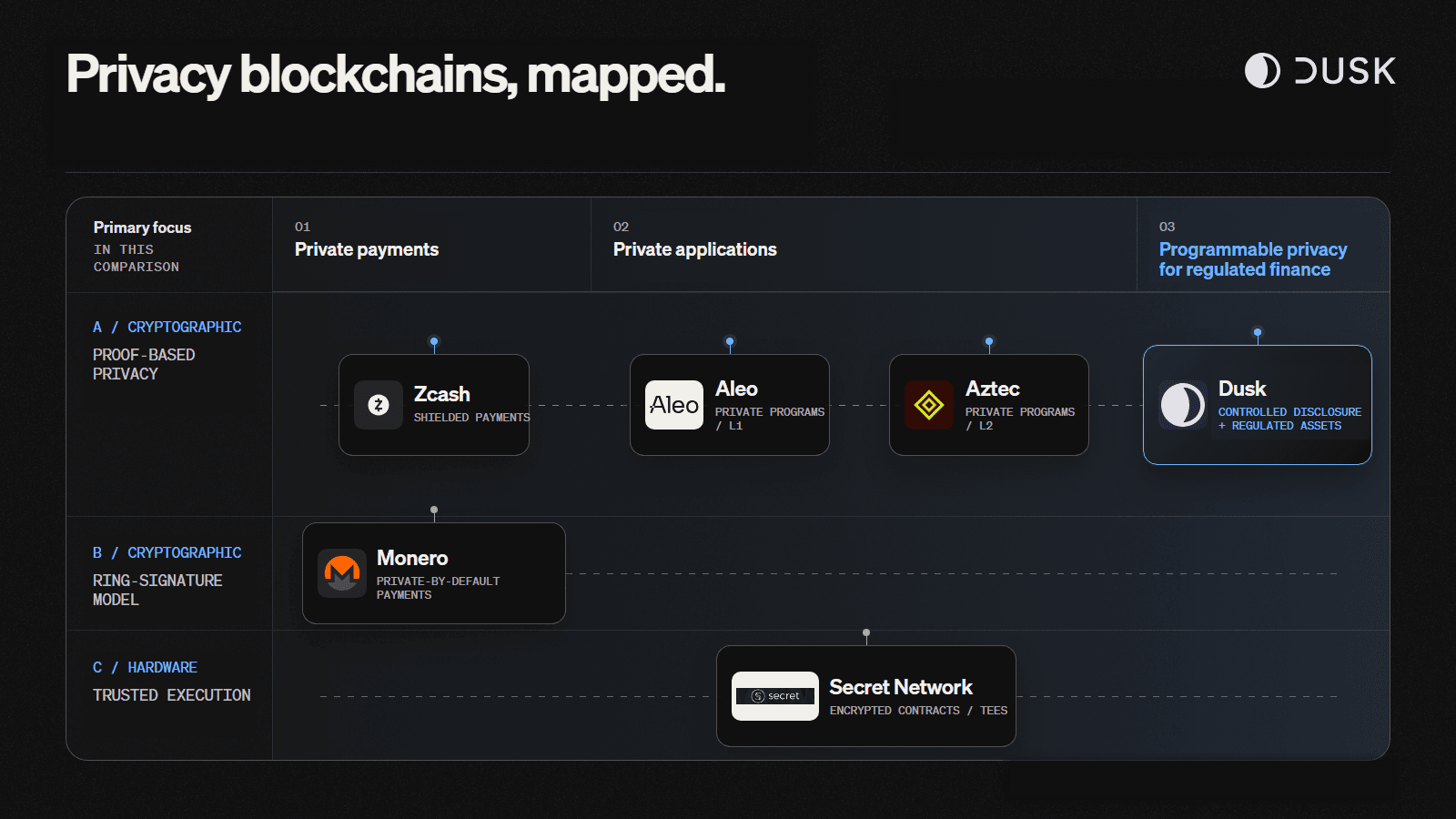
Privacy blockchains solve different problems.
Zcash and Monero focus on private payments. Aleo and Aztec extend privacy into programmable state and applications. Secret Network uses trusted hardware for encrypted computation. Dusk combines selective disclosure, general-purpose smart contracts, and regulated-asset infrastructure on a sovereign Layer 1, giving developers a base for privacy applications beyond payments.
A useful comparison starts with four questions:
- What information stays private?
- How is that privacy enforced?
- Who can receive or verify disclosed information?
- Can developers build applications beyond payments?
Privacy blockchain comparison
| Network | Architecture | Privacy model | Counterparty visibility and programmability |
|---|---|---|---|
| Dusk | Sovereign Layer 1, plus DuskEVM execution | PLONK-based privacy, selective disclosure, public Moonlight accounts, and the Phoenix shielded model | Phoenix receivers can identify senders while public observers cannot. General-purpose Rust and WebAssembly contracts run directly on Dusk L1, with EVM-compatible applications available through DuskEVM. |
| Zcash | Sovereign Layer 1 | Optional shielded payments using zk-SNARKs, alongside transparent transactions and viewing capabilities | A shielded recipient does not learn the sender address from the transaction receipt. The network is primarily payment-focused rather than a general-purpose application platform. |
| Monero | Sovereign Layer 1 | Private-by-default payments using ring signatures, stealth addresses, confidential amounts, and view keys | The recipient does not learn the sender wallet address from the payment. Monero is digital-cash infrastructure rather than a general-purpose smart-contract platform. |
| Aleo | Sovereign Layer 1 | Zero-knowledge programs with private records and private or public inputs and outputs | Counterparty visibility depends on program design. Applications can use programmable private state. |
| Secret Network | Cosmos-based Layer 1 | Encrypted smart-contract inputs, outputs, and state processed inside trusted execution environments | Disclosure is application-defined. Programmable privacy relies on enclave hardware and attestation. |
| Aztec | Ethereum Layer 2 under development | Zero-knowledge smart contracts with private and public functions and state, settled to Ethereum | Counterparty visibility is application-defined. The system targets general private applications anchored to Ethereum. |
This is a representative comparison. In practice, privacy also depends on wallet behavior, application design, network metadata, bridges, and how users move between private and public state.
Privacy-preserving does not always mean anonymous
An anonymous payment system tries to prevent even the recipient from learning the sender’s protocol address. A privacy-preserving system can keep a transaction confidential from the public while still allowing the parties to know who they are dealing with.
Dusk’s privacy model (Phoenix) follows the second approach. Public observers cannot see the participants or amount, but the receiver can cryptographically identify the sender. Recipients of shielded Zcash and private Monero payments do not learn the sender address from the transaction receipt.
That distinction changes what can be built for regulated transfers. A Dusk application can bind a sending key or wallet to a verified participant, allow the receiver to establish which cryptographic counterparty sent the transfer, and disclose additional evidence only to authorized parties.
This can support Travel Rule and counterparty-verification workflows without publishing the relationship to the entire network. It does not make a transfer automatically Travel Rule compliant. Regulated intermediaries still need identity binding, screening, recordkeeping, and a secure way to transmit required originator and beneficiary information.
Programmability expands the difference. DuskVM runs general-purpose Rust and WebAssembly smart contracts directly on the Dusk Layer 1. DuskEVM adds a Solidity-compatible path and privacy-oriented infrastructure through Hedger. Dusk therefore combines shielded value mechanics with the ability to build broader financial applications, although its architecture differs from both Zcash and Ethereum.
What privacy blockchains actually keep private
The term “privacy blockchain” can refer to several distinct properties:
- Transaction privacy conceals a sender, recipient, amount, balance, or transaction graph.
- Private computation executes application logic without exposing every input, output, or piece of state.
- Selective disclosure reveals defined information to an authorized party without publishing it universally.
- Metadata protection limits information leaked through timing, fees, network traffic, contract calls, or movement between private and public systems.
A network can provide one of these properties without providing all of them.
The enforcement model matters just as much as the privacy boundary. Zero-knowledge proofs establish that rules were followed without revealing protected inputs. Trusted execution environments process encrypted data inside isolated hardware. Ring-signature systems obscure which member of a set authorized a payment. Each approach creates different trust, programming, and operational assumptions.
Dusk combines selective disclosure with programmable finance
Dusk is a sovereign, programmable Layer 1. DuskVM executes general-purpose Rust and WebAssembly smart contracts directly on the L1, giving developers a base for privacy applications, regulated assets, identity systems, exchanges, and other dApps with zero-knowledge or selective-disclosure features. DuskEVM provides an EVM-compatible execution path for Solidity applications and privacy-oriented flows through Hedger.
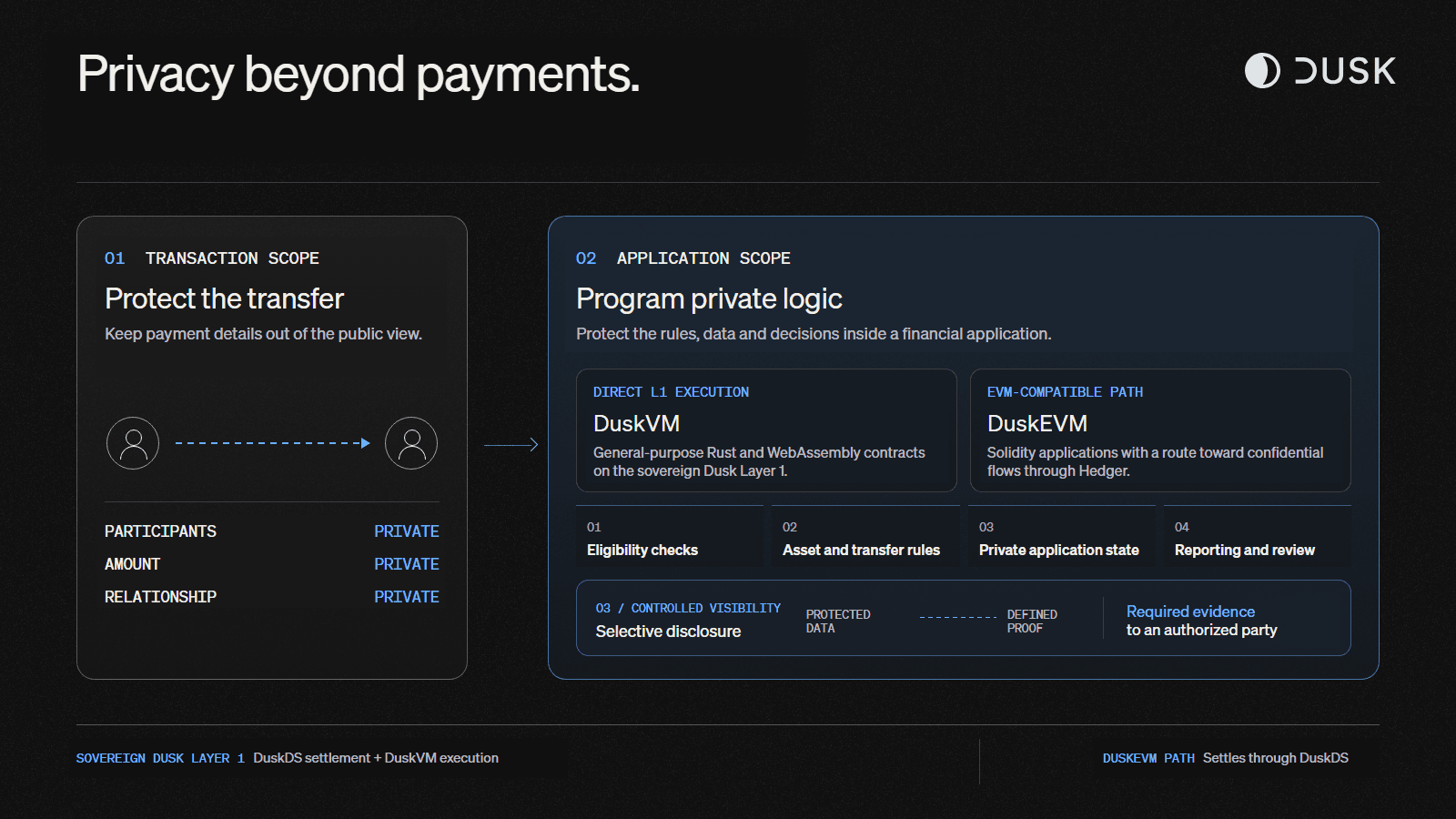
Dusk’s native transaction architecture distinguishes transparent Moonlight accounts from the shielded Phoenix model. Phoenix conceals participants and amounts from public observers while allowing the receiver to identify the sender. New Phoenix transactions were disabled on Dusk mainnet at the Boreas restart in June 2026 and will be re-enabled in a future network upgrade. Historical Phoenix state and replay support remain. Current applications can also implement privacy and zero-knowledge functionality through DuskVM and DuskEVM.
This architecture treats financial privacy as controlled visibility. Investors do not need to publish every balance and transfer to the market. At the same time, a counterparty, issuer, auditor, venue, or supervisor may need evidence about a specific participant, position, or transaction. Dusk combines zero-knowledge capabilities, counterparty-aware privacy, public execution where appropriate, and selective disclosure so information can be shared for a defined purpose.
Dusk’s privacy architecture uses a PLONK-based proving stack. Dusk has also contributed to the engineering and follow-up research around PLONK through its pure-Rust implementation and Dusk-affiliated work on plookup and PlonKup. These lookup techniques make common circuit constraints more efficient and help turn zero-knowledge research into practical protocol infrastructure.
The result is an application environment where confidential assets, eligibility checks, controlled transfers, settlement, and reporting can coexist. Privacy is part of Dusk’s wider institutional and real-world-asset design, not a payment feature added in isolation.
Zcash offers optional shielded payments
Zcash is a sovereign Layer 1 focused on payments. Its shielded transactions use zk-SNARKs to conceal sensitive payment information, including transaction relationships and values. The network also supports transparent transactions, so the privacy obtained depends on the addresses and wallet flow used.
Zcash supports viewing capabilities and payment-disclosure mechanisms for sharing selected transaction information. Its closest overlap with Dusk is protocol-level shielded value transfer backed by zero-knowledge proofs. The main difference is scope. Zcash principally focuses on private payments, while Dusk combines its transaction models with general application execution and infrastructure for regulated assets.
Monero provides private-by-default digital cash
Monero makes privacy the default for payments. Ring signatures make it difficult to identify which member of a set authorized a transaction. Stealth addresses prevent public recipient-address reuse, while confidential transaction techniques conceal amounts. A private view key can provide visibility into incoming activity for accounting or auditing.
This default privacy model distinguishes Monero from networks where users choose between public and shielded transactions. Its focus is digital cash, not general-purpose smart contracts. Monero therefore addresses a narrower problem than privacy-preserving application networks and institutional asset infrastructure.
Aleo programs private state with zero knowledge
Aleo is a programmable Layer 1 built around zero-knowledge proofs. Programs can accept private and public inputs and produce private or public outputs. Sensitive user state can be represented as encrypted records, with proofs allowing the network to verify valid state transitions without learning the protected contents.
Aleo and Dusk both extend zero knowledge beyond payments and scaling. Aleo emphasizes private programs and user-owned records. Dusk combines its application environments with Phoenix and Moonlight transaction models, selective disclosure, deterministic settlement, and a focus on tokenized financial assets.
Secret Network relies on trusted hardware
Secret Network supports programmable privacy through CosmWasm-based contracts. Contract inputs, outputs, and state are encrypted and processed within trusted execution environments, historically based on Intel SGX. Viewing keys and permits give users or authorized third parties access to protected contract data.
This creates a different trust model from proof-based privacy. Zero-knowledge systems rely on cryptographic proofs that can be independently verified. Trusted-execution systems depend on hardware isolation, attestation, key management, and the security assumptions of the enclave platform. Both can support private applications, but their risks and operating models are not interchangeable.
Aztec brings private smart contracts to an Ethereum Layer 2
Aztec is developing a privacy-first Ethereum Layer 2. Its model supports private and public functions as well as private and public state. Private functions execute and generate proofs on the user’s device, while public execution occurs on the network and rollup proofs settle to Ethereum.
Aztec is relevant for applications that want privacy while remaining anchored to Ethereum. Dusk is a sovereign Layer 1 with its own consensus, settlement, transaction models, and application environments. Aztec’s documentation currently warns that the system remains under development and should not yet be trusted with meaningful real-world secrets.
How Dusk differs from privacy coins and private-compute networks
The term “privacy coin” usually describes a currency designed to conceal payment activity. Dusk is privacy-preserving application infrastructure.
Its general-purpose L1 contracts can support:
- investor eligibility and wallet binding
- transfer restrictions and disclosure rights
- corporate actions
- private application state
- delivery-versus-payment settlement
These capabilities are particularly relevant to tokenized securities and other real-world assets. Public blockchains can expose commercially sensitive positions and relationships. Fully opaque systems can make legal reporting and controlled disclosure difficult.
Dusk’s model protects information from the wider market while allowing defined parties to receive the evidence their role requires. Privacy, verifiability, application logic, and settlement operate as parts of the same financial infrastructure.
Which privacy blockchain fits which use case?
The strongest choice depends on what the application needs.
- Private payments. Zcash and Monero are established payment-focused designs with different optional and default privacy models.
- Zero-knowledge programs. Aleo and Aztec focus on programmable private state and execution.
- Hardware-based private contracts. Secret Network provides encrypted computation through trusted execution environments.
- Regulated assets and institutional workflows. Dusk combines general-purpose L1 smart contracts, zero-knowledge capabilities, selective disclosure, deterministic settlement, transparent transaction infrastructure, and an EVM-compatible application path.
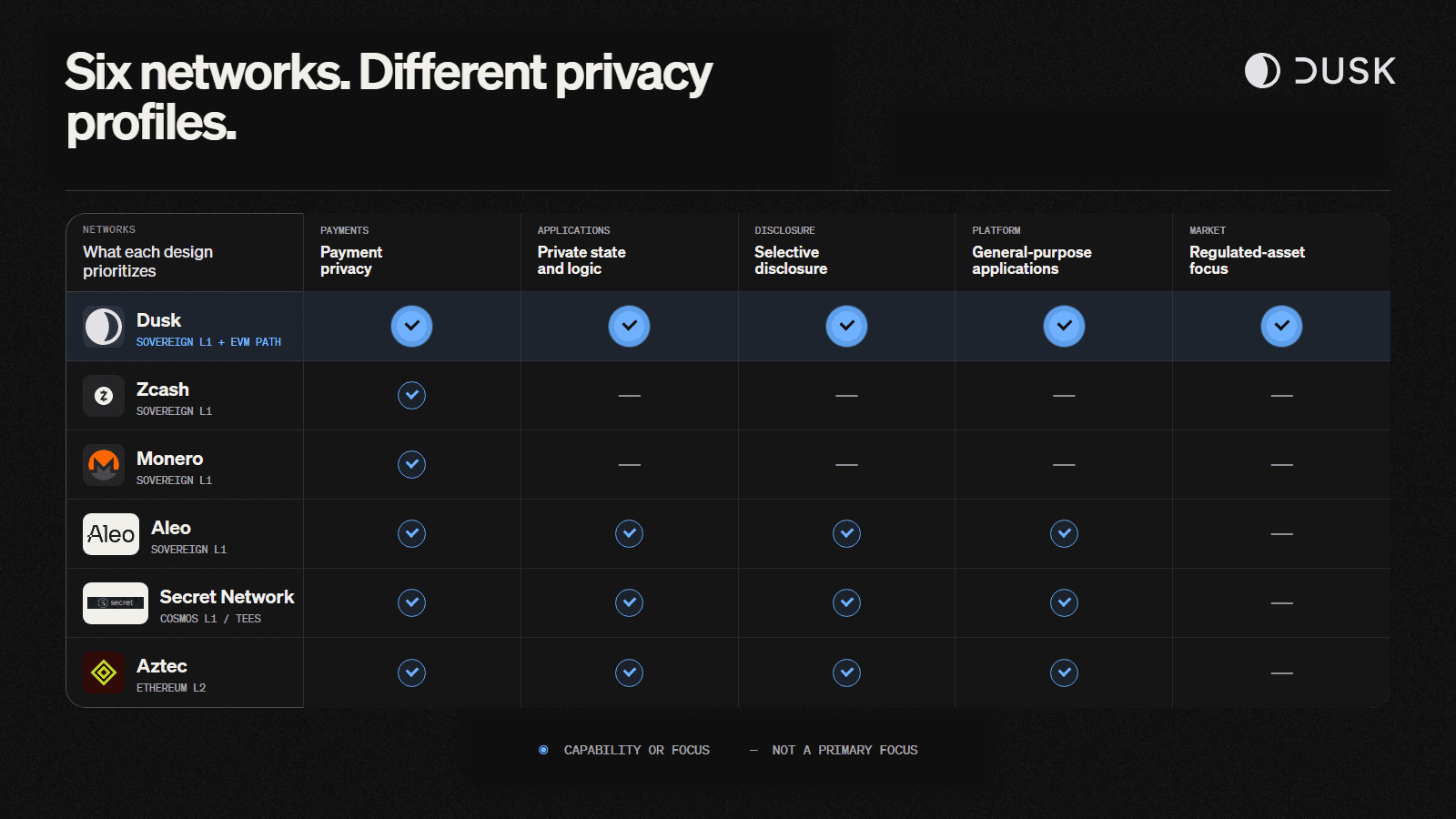
A serious evaluation should examine the privacy boundary, disclosure mechanism, trust assumptions, application model, network maturity, wallet support, and metadata exposed when users cross into public systems.
Dusk stands apart by treating privacy as a programmable requirement for regulated finance, not only as a way to conceal payments.
Frequently asked questions
Is Dusk a privacy blockchain?
Yes, although privacy-preserving is more precise than fully anonymous. Dusk supports general-purpose applications with zero-knowledge and selective-disclosure capabilities through DuskVM and DuskEVM. Its Phoenix architecture provides shielded native transfers where the receiver can identify the sender while public observers cannot. New Phoenix transactions are currently disabled on mainnet and will be re-enabled in a future network upgrade.
How is Dusk different from Zcash?
Both use zero-knowledge proofs for shielded value transfer, but their sender-visibility and application models differ. A shielded Zcash recipient does not learn the sender address from the transaction receipt. A Dusk Phoenix receiver can identify the sender while the public cannot. Zcash principally focuses on private payments. Dusk adds general-purpose L1 smart contracts, an EVM-compatible execution path, selective disclosure, deterministic settlement, and infrastructure intended for regulated and tokenized assets.
How is Dusk different from Monero?
Monero provides private-by-default payments using ring signatures, stealth addresses, and confidential transaction techniques. The payment recipient does not learn the sender wallet address from the protocol receipt. Dusk’s Phoenix model lets the receiver identify the sender while protecting both parties from public observers. Dusk also supports general-purpose programmable applications, selective disclosure, and transparent execution where a workflow requires it.
Are all private smart contracts based on zero-knowledge proofs?
No. Dusk, Aleo, and Aztec use zero-knowledge technology in their privacy architectures. Secret Network processes encrypted contract data in trusted execution environments. These approaches have different trust, performance, and verification properties.
Why does selective disclosure matter?
Selective disclosure allows a user or application to reveal defined information to an authorized party without making that information public. This is useful when confidentiality must coexist with auditing, supervision, eligibility checks, or legal reporting.
Primary sources
Dusk
- Core values and selective disclosure
- Cryptography documentation
- Transaction models
- Assets and regulations
- General-purpose smart-contract development
- Boreas and Phoenix status
- Participant visibility
- PLONK implementation
- plookup research paper
- PlonKup research paper
Other networks and regulatory context
- Zcash shielded and transparent transactions
- Zcash payment disclosures
- Zcash shielded recipient visibility
- Monero ring signatures
- Monero stealth addresses and view keys
- Monero recipient visibility
- AleoVM specification
- Secret Network privacy technology
- Aztec documentation
- FATF virtual-asset and Travel Rule guidance