Tokenized Securities: From Wrappers to Native Issuance
Bonds, shares and funds can all be brought onchain as digital tokens. This is tokenization. For investors, it can open access to a wider range of securities and reduce the delays involved in completing trades and receiving payments.
Financial institutions need to check who can buy an asset, record ownership changes and pay the right investors. Blockchains can use smart contracts to automate parts of this work, including checking transfers against the asset's rules and updating the records used for payments.
By reducing manual work and reliance on intermediaries, tokenization can lower the cost of issuing and managing securities for companies. Those savings can also support lower fees for investors.
How a security is tokenized determines where ownership is recorded and how transfers and payments are handled. A wrapper creates a token backed by an existing security held elsewhere. Native issuance creates the security directly onchain. Dusk is built to support native issuance and the market infrastructure around it.
Raising capital with bonds
A bond allows a company to borrow money from investors for an agreed period. The company receives funding upfront and commits to paying interest and returning the borrowed amount on a specified date.
Imagine a European company financing its expansion with a five-year bond. An investor buys one €1,000 bond. Under its terms, the company pays that investor €50 each year and returns the €1,000 at the end of year five. That final repayment date is the bond's maturity.
The company can put the money towards its expansion, but the work of managing the bond has only begun. It needs to know who should receive each payment, including when the original investor sells to someone else. Bringing these processes together is part of the opportunity for tokenization in SME financing.
The wrapper model
Wrapper tokenization makes an existing security available through a separate token. The original security stays in its existing custody arrangement, while investors buy and sell the token through blockchain applications.
For the company's bond, a provider could arrange for bonds to be held by a custodian and issue tokens backed by them. The investor holds a token whose terms define their entitlement to interest and repayment. Selling that token changes its holder; the backing bond remains in custody.
This can open an existing investment to new distribution platforms, but it can also add a wrapper provider to the custodians and administrators already handling the bond. The provider must continually match the token records against the bonds held in custody to check that the tokens remain fully backed. This is reconciliation. The provider must also arrange for bond payments to reach the right token holders. These extra handoffs can add fees and create more opportunities for mismatched records or delayed payments.
The rights attached to a token therefore matter as much as its blockchain address. A token representing a claim on a bond differs from one that only tracks the bond's price. Price exposure alone does not give an investor ownership of the bond or a right to its payments.
The case for native issuance
Native issuance creates the security directly on a blockchain, with its ownership recorded there from the outset. The bond's terms and applicable law must recognize that record. The issuer and its service providers can then organize transfers and payments around it.
For the European company, this would mean issuing its bond on Dusk. Once an investor's purchase is accepted and paid for, their holding is recorded onchain. A later sale updates that record, which also helps determine who receives the next interest payment.
Native issuance can remove the separate wrapper provider and the need to reconcile onchain tokens with securities held elsewhere. The bond's own ownership record can support issuance, trading and payments. Institutions can apply transfer rules and identify who should be paid from that record, instead of repeatedly matching data between separate systems.
For bond and share markets, this means fewer intermediaries and fewer records to reconcile. That can lower administration costs and reduce the chances of mismatched holdings, delayed transfers or payments reaching the wrong investor.
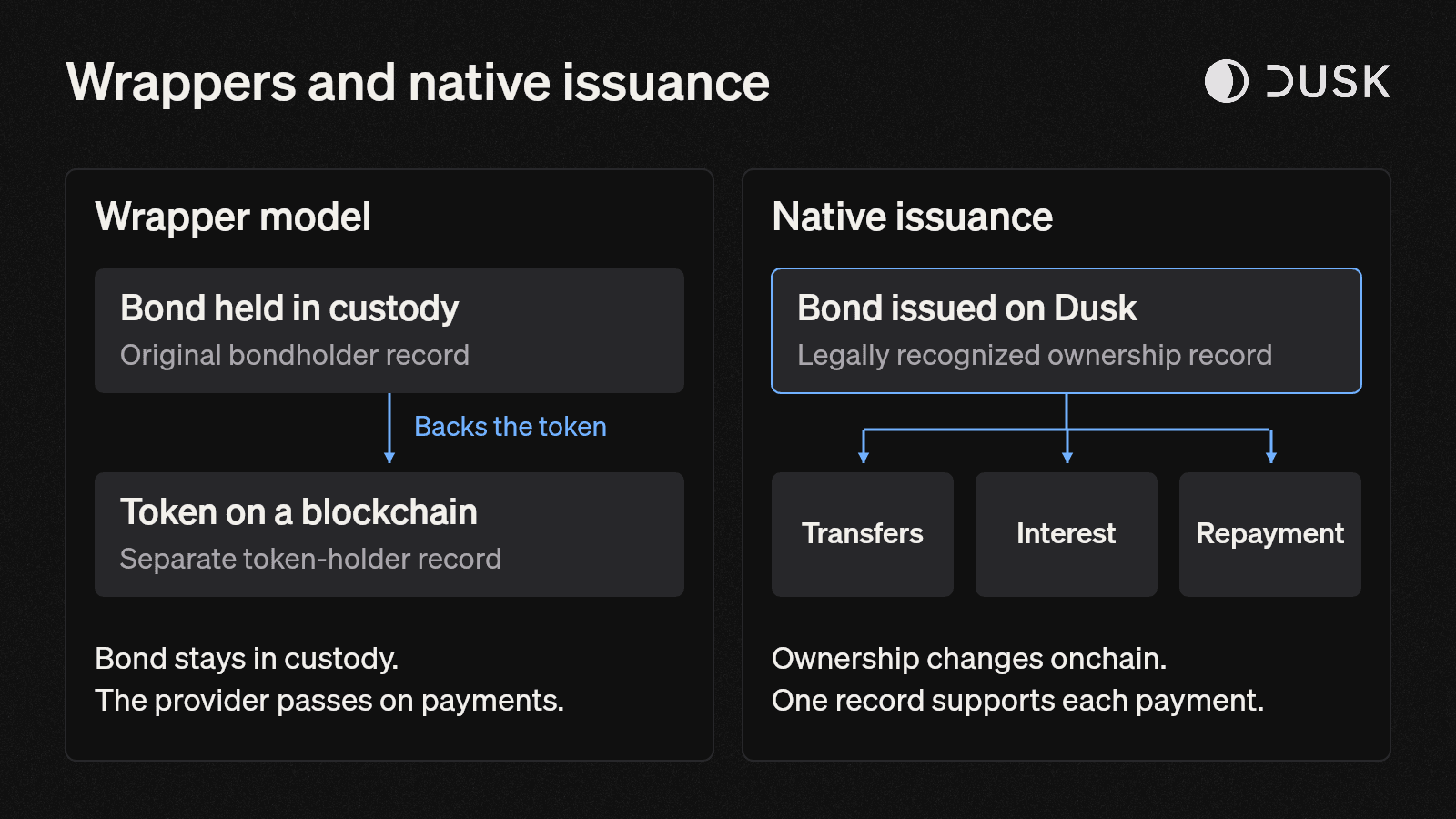
Both approaches are forms of tokenization. Wrappers can help distribute investments that already exist. Native issuance offers a stronger foundation for markets designed to operate onchain because institutions can build the full process around the asset itself. That is the opportunity Dusk is pursuing.
The lifecycle of an onchain bond
An onchain bond still needs a process for accepting investors, completing trades and paying holders. The difference is that these steps can use the same ownership record.
Before the first purchase, the investment service checks the buyer's identity and whether they meet the bond's requirements. A smart contract can use that approval to allow or reject a transfer. It does not replace the institution responsible for verifying the investor.
Suppose the investor sells after two years. They need an eligible buyer and an agreed price, which may be above or below the original €1,000. The sale must deliver the bond to the buyer and the money to the seller.
Delivery versus payment links those two actions. If both the bond and the payment asset are onchain and the application supports it, they can transfer together or neither transfers. A payment through a separate bank account needs a connection that confirms the money has arrived.
The bond's terms set the date used to identify who receives the next interest payment. If the buyer holds the bond on that date, the next €50 goes to them. The administrator can use the updated ownership record to calculate the payment, and a funded payment contract can distribute it according to the bond's rules.
At the end of year five, the company repays €1,000 per bond to the holders entitled to receive it, alongside the final interest payment. After repayment, the bond is marked as redeemed so it no longer trades as an outstanding debt. Repayment still depends on the company's ability to pay, and selling early depends on finding a buyer.
Tokenized equities and funds
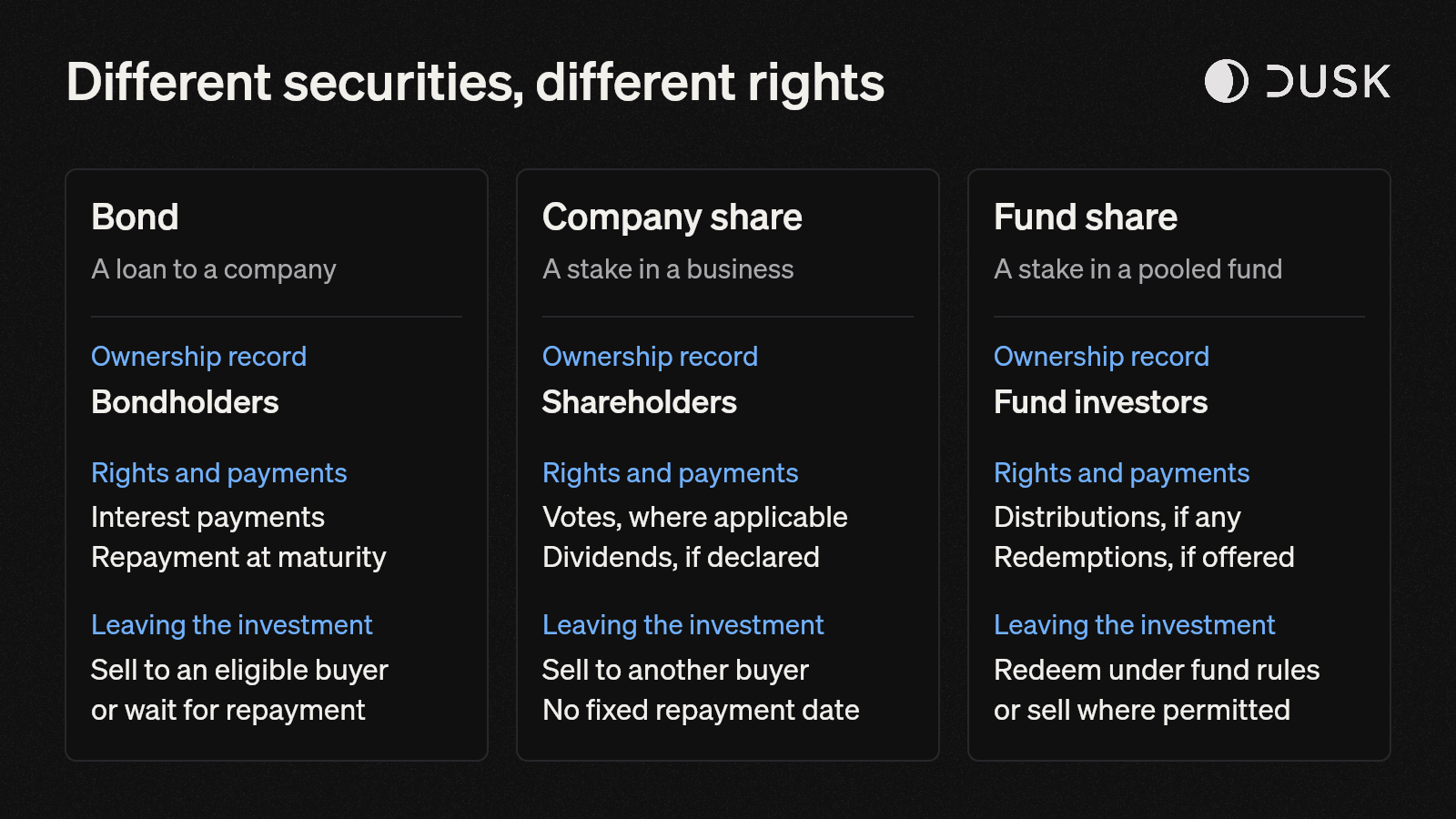
Tokenization also applies to company shares and investment funds. The ownership record serves a similar purpose, but each investment gives its holder different rights.
A company can raise money by selling shares, also called equity. The investor then owns part of the business. Depending on the share class, they may vote on company decisions and receive dividends when declared. Unlike the bond in our example, ordinary shares have no fixed repayment date. An onchain share register can help identify who may vote and who should receive a dividend.
A fund pools investors' money to buy a portfolio. It could buy the company's bond alongside other investments. Investors own shares in the fund, rather than each bond it holds. Tokenizing those fund shares does not automatically tokenize the investments inside the portfolio.
In an open-ended fund, investors generally buy shares from the fund or redeem them for cash. The price is usually based on net asset value, or NAV: the value of the fund's assets after liabilities, divided by the number of shares. At a NAV of €10 per share, €1,000 buys 100 shares before fees or adjustments. Investors in publicly traded closed-ended funds generally sell to another buyer instead, at a market price that can differ from NAV.
Money market funds hold short-term investments and are often used for cash management. As the ECB explains, transferring a tokenized fund share and redeeming it for cash are different processes. Eligible investors may be able to transfer shares on a weekend while cash redemptions remain subject to the fund's dealing hours.
Dusk and Europe's onchain markets
Dusk's market infrastructure gives developers tools for issuing securities, checking investor eligibility and coordinating trades and payments. Privacy is part of that work. An investor should be able to prove they meet a purchase requirement without publishing identity documents on a blockchain. Citadel supports proofs of valid credentials, while the investment service decides which credentials it accepts. Selective disclosure addresses a related need: giving authorized parties access to relevant information while protecting other details.
The legal and operational arrangements must support the technology. A company and its market operators need the necessary authorizations, legal terms and payment arrangements to issue regulated securities on Dusk. Dusk provides the infrastructure; it does not issue the securities. The EU's DLT Pilot Regime provides a supervised framework for blockchain-based trading and settlement, including specific authorization for operators combining both functions in a DLT trading and settlement system.
For European markets, native issuance offers a way to connect company financing with the ongoing work of managing investments. A company can maintain its bondholder record as trades settle and use it throughout the bond's life. Interoperability can connect additional applications to that asset, giving eligible investors more ways to access it.
This is the future Dusk is working towards: securities that originate onchain, with the infrastructure to manage them from the first investment to the final payment. Explore native issuance on Dusk to see how that model works.